很开心能参与论文 Focal-Feature Regression Kriging (FFRK) 在 Geographical Analysis 的发表。感谢宋老师给予我参与这一研究的机会,也很荣幸能与 MIT 的罗鹏师兄合作。感谢宋老师和师兄一直以来的悉心指导。每一次讨论都让我受益匪浅,也让我对空间预测与 Kriging 有了更加系统和深入的认识。
I am very glad to have contributed to the publication of Focal-Feature Regression Kriging (FFRK) in Geographical Analysis. I am grateful to Prof. Yongze Song for giving me the opportunity to join this study, and it was a real honor to work with Peng Luo from MIT. I also thank Prof. Song and Peng for their careful guidance. Each discussion helped me better understand spatial prediction and Kriging in a more systematic way.
在这项研究中,我主要负责 FFRK 方法原型代码的重构与优化、实验部分代码实现以及部分可视化工作。这是我参与的第一篇空间方法理论研究论文,也是第一次参与持续一年以上的研究项目。研究初期糟糕的文件管理让我在后期多次修改实验代码时吃了不少苦头。几个月后论文返修,再回头改代码时,我常常找不到当时跑出最终结果的版本。也非常感谢师兄一直以来的耐心。这段经历让我对代码管理有了更深的教训。
In this study, I mainly worked on refactoring and optimizing the prototype code for the FFRK method, implementing the experimental code, and preparing part of the visualizations. This was my first theoretical spatial-methods paper, and also the first research project I worked on for more than a year. Poor file management at the beginning caused real trouble when I had to revise experimental code later. Months after the first submission, I often had to look back and search for the exact version that had produced the final results. I am especially grateful for Peng's patience throughout this process. The experience gave me a much stronger lesson in code management.
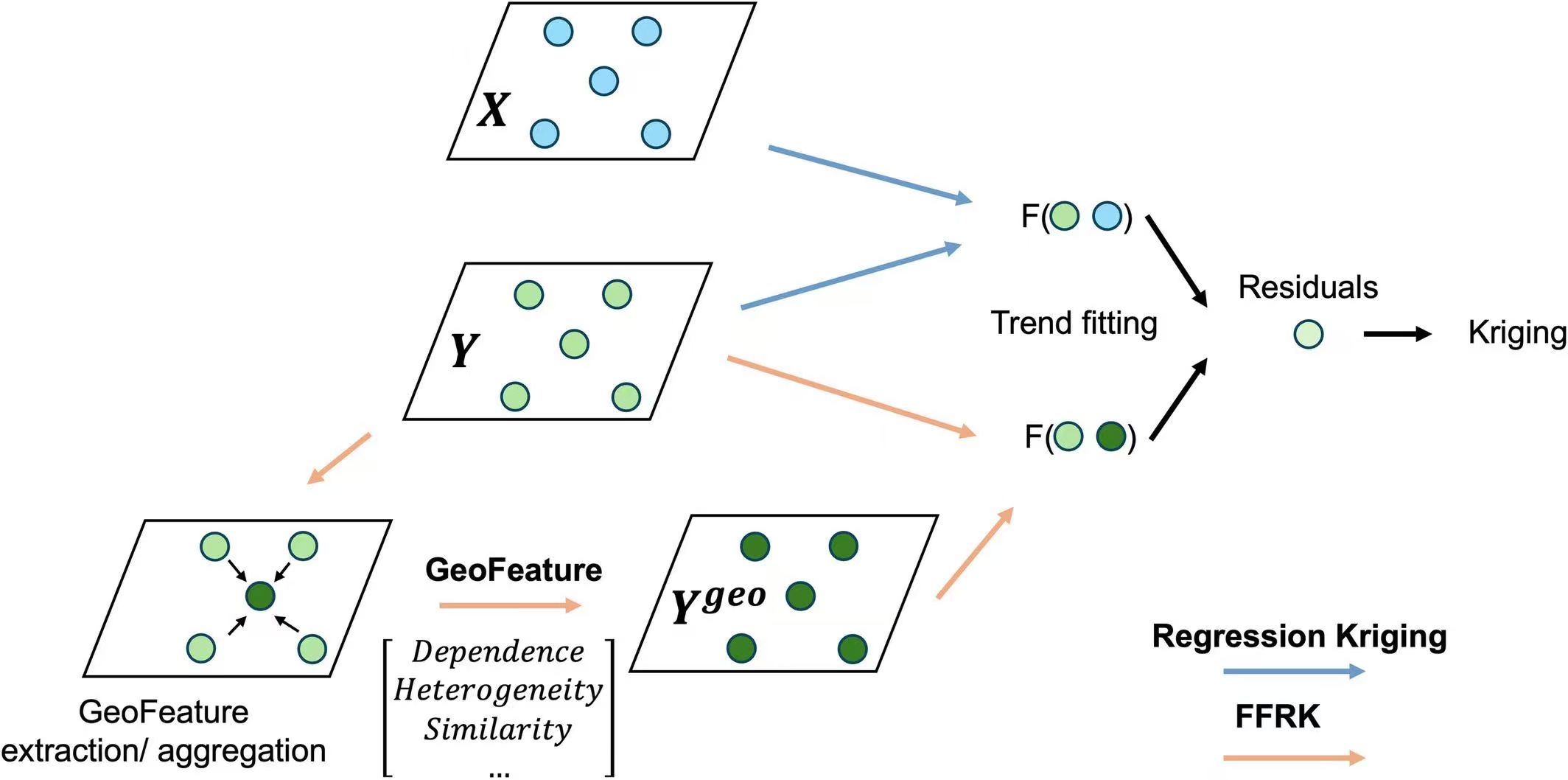
师兄提出的 FFRK 方法在保持 Kriging 理论框架的基础上,通过提取空间局部邻域特征来刻画空间局部依赖性、空间异质性以及地理相似性。它用空间自身结构替代外部解释变量,从而处理空间插值中的非平稳性问题。相比空间分区类方法,它能够获得更加平滑且稳定的预测结果。相比传统趋势面模型,在缺乏高质量解释变量的情况下也能取得更好的预测效果。
The FFRK method proposed by Peng keeps the theoretical framework of Kriging while using local spatial neighborhood features to describe local spatial dependence, spatial heterogeneity, and geographic similarity. It uses the structure of space itself in place of external explanatory variables, which helps address non-stationarity in spatial interpolation. Compared with spatial partitioning methods, it produces smoother and more stable predictions. Compared with conventional trend-surface models, it can also perform better when high-quality explanatory variables are not available.
再次感谢宋老师和罗鹏师兄引领我真正进入地理空间理论研究。也希望将这项工作作为起点,未来能在这个方向继续做出更多有意思、有价值的探索。
I am again grateful to Prof. Song and Peng Luo for guiding me into theoretical geospatial research. I hope to take this work as a starting point and continue making meaningful explorations in this direction.