纪第一篇(共)一作顶刊发表。很高兴论文 Explainable second-dimension spatial association between park sentiment and built-social environments 在 Cities 发表。这是我第一篇共同一作的顶刊论文,也记录了我从一个相对简单的研究想法,逐步走向更系统空间方法理解的过程。
This post records the publication of my first co-first-author paper in a leading journal. I am glad that Explainable second-dimension spatial association between park sentiment and built-social environments was published in Cities. It also records how a relatively simple research idea gradually led me toward a more systematic understanding of spatial methods.
这篇论文一开始的想法非常简单。我们原本只是想基于公园社交媒体情感数据,结合最优参数地理探测器 (OPGD),分析情感与环境因子的多尺度关系。随着研究推进和学习深入,我逐渐意识到宋老师提出的 Second Dimension of Spatial Associations (SDA) 这个概念很有意思。
The initial idea of this paper was quite simple. We planned to use park-related social media sentiment data and the optimal-parameter geographical detector (OPGD) to analyze multiscale relationships between sentiment and environmental factors. As the study progressed, I gradually realized how interesting Prof. Yongze Song's concept of the Second Dimension of Spatial Associations (SDA) was.
以下内容均为个人理解与思考。
The following notes are my personal understanding and reflections.
传统 Kriging 方法通常基于一系列空间统计假设,如平稳性 (stationarity) 和各向同性 (isotropy)。本质上,它是在模型结构层对空间依赖 (spatial dependence) 进行显式参数化,通过变差函数或协方差函数来刻画空间依赖结构。这种显式建模方式具有较强的可解释性,并能够在其假设条件下提供最优线性无偏预测。
Traditional Kriging methods are usually built on spatial statistical assumptions such as stationarity and isotropy. In essence, they explicitly parameterize spatial dependence at the model-structure level, using a variogram or covariance function to describe the spatial dependence structure. This explicit modeling approach is interpretable and can provide best linear unbiased prediction under its assumptions.
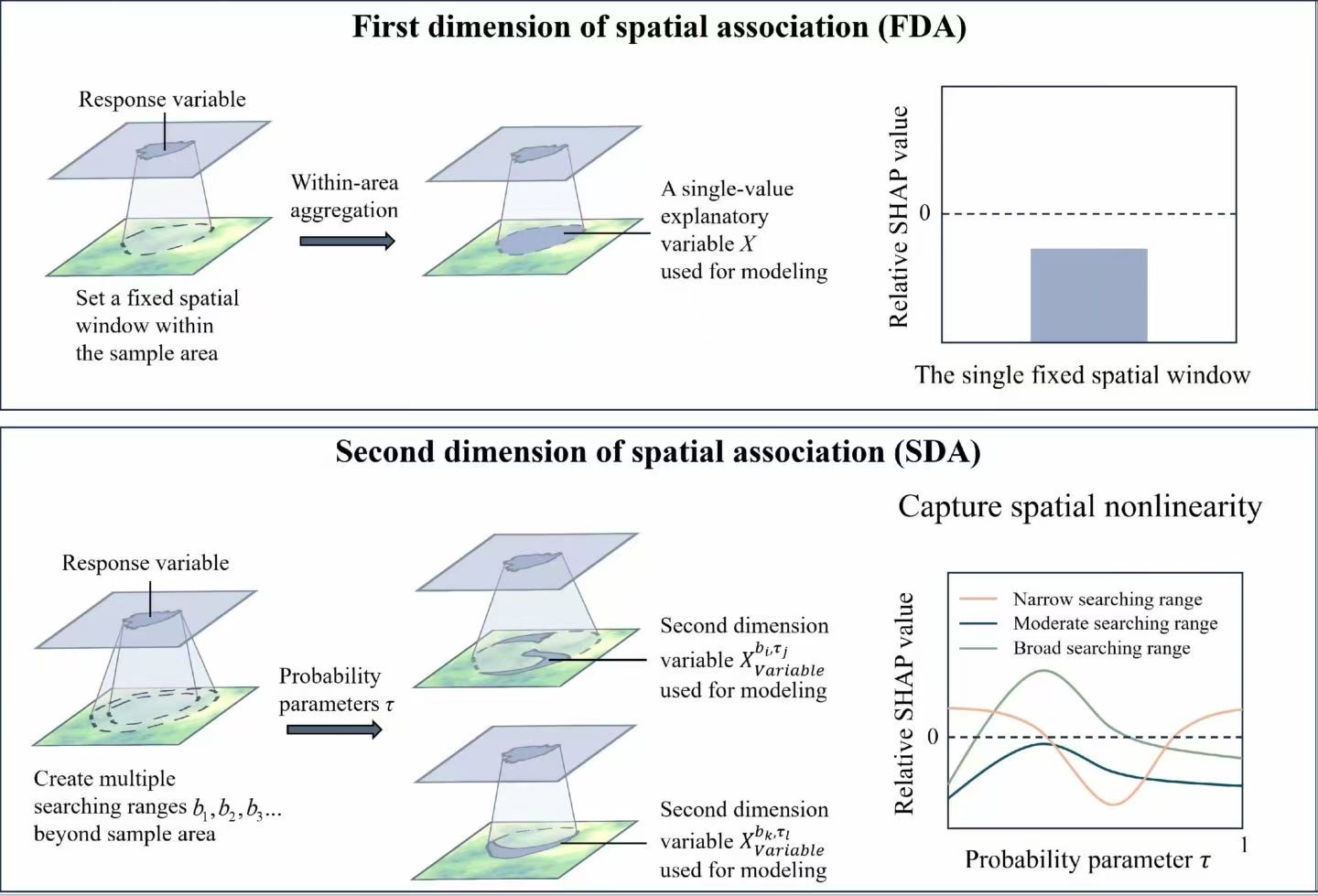
SDA 提供了另一种思路。它不再在模型层显式参数化空间协方差结构,而是在特征层通过 b-tau(尺度与分位)参数构造空间表达,并将空间环境信息嵌入特征中,从而形成一种由数据驱动表达空间的建模方式。换句话说,SDA 将空间依赖从模型结构层中的显式参数化表达,转化为特征表示层中的隐式嵌入表达,从而弱化了对先验空间结构的依赖。
SDA offers another way of thinking. Instead of explicitly parameterizing the spatial covariance structure at the model level, it constructs spatial representations at the feature level through b-tau parameters, namely scale and quantile, and embeds spatial environmental information into features. In other words, SDA shifts spatial dependence from explicit parameterization in the model structure to implicit embedding in feature representation, reducing reliance on a predefined spatial structure.
但是,当我们通过构造特征来表达空间关联 (spatial associations),而不再依赖模型中的显式空间假设时,一个问题也随之出现。我们是否仍然能够清晰地解释空间关联的来源?
However, when spatial associations are expressed through constructed features rather than explicit spatial assumptions in the model, a new question appears. Can we still clearly explain where the spatial associations come from?
在这一问题的背景下,我们在 SDA 框架下构建了 Explainable Second Dimension of Spatial Association (ESDA)。我们通过多尺度 (b) 与分位 (tau) 变量构造,引入随机森林进行建模,并结合 SHAP 对模型输出进行解释。结果显示,公园情感与环境因子的空间关联具有明显的非线性特征 (spatially nonlinear effects),其作用方向会随尺度与背景条件变化 (effect direction varies),并在部分情形下表现为作用反转 (sign-reversing effects)。
Against this background, we developed Explainable Second Dimension of Spatial Association (ESDA) within the SDA framework. We constructed multiscale b and quantile tau variables, used random forests for modeling, and applied SHAP to interpret model outputs. The results showed that the spatial associations between park sentiment and environmental factors had clear spatially nonlinear effects. Their effect directions changed with scale and contextual conditions, and in some cases showed sign-reversing effects.
从这个角度看,基于固定空间假设的传统 Kriging,在标准设定下可能较难刻画这种随尺度与环境条件变化的复杂空间关联结构。空间关联不一定只能被预先设定成一个稳定结构,也可以通过依赖尺度与环境背景的条件来表达。
From this perspective, traditional Kriging based on fixed spatial assumptions may have difficulty, under standard settings, capturing this kind of complex spatial association structure that changes with scale and environmental context. Spatial associations do not have to be predefined as a stable structure. They can also be expressed through conditions that depend on scale and context.
或许,如“横看成岭侧成峰”,空间关联也可随尺度与表达而显其形。
Perhaps, as Su Shi wrote, "Viewed horizontally as a range, and from the side as a peak"; spatial associations may also reveal their form through scale and representation.